Breaking News
Showing posts with label hydrates. Show all posts

Friday, 7 April 2017

Gulf Stream is heating up

El Niño 2017 is strengthening. On March 24, temperatures in Africa were as high as 50.6°C or 123°F.


The image below shows wildfires hitting Northern China and Far East Russia on April 4, 2017. The Amur River, which forms the boundary between China and Russia, is visible on this Terra/MODIS satellite image, with red dots indicating wildfires.


Emissions associated with such wildfires can be huge, as illustrated by the image below. On April 4, 2017, sulfur dioxide (SO₂) levels were as high as 766.29 µg/m³ at a spot (marked by the green circle, left panel) north of the Amur River, in Russia, while carbon dioxide (CO₂) levels were as high as 513 parts per million at that same spot and carbon monoxide (CO) levels there were as high as 17,402 parts per billion. 


These high sulfur dioxide levels indicate that sulfur that has over the past few decades been deposited there from smokestacks of coal-fired power plants, tailpipes of vehicles, etc., can re-enter the atmosphere as a result of wildfires, confirming the conclusion of earlier studies such as by Hegg et al.

This indicates that sulfur levels in the atmosphere are higher than previously estimated, given that most previous estimates were mainly based on real-time emissions from industrial activity at the time. When adding revolitalization of previously-deposited sulfur (due to wildfires) into the picture, estimates for such aerosols' masking effect of the full wrath of global warming will be higher than previously thought, and increasingly so, as wildfires are becoming painfully more common as Earth continues to warm up.

This also implies that it becomes increasingly plausible that, when aerosol levels suddenly drop during heatwaves, wet bulb temperature starts crossing sustainability limits for humans without air-conditioning. Note that in July 2016, weather conditions at a spot in the U.S. came perilously close to this limit.

What could further contribute strongly to a rapid rise in global temperature is the combination of decline of Earth's snow and ice cover and eruptions of methane from the seafloor of the Arctic Ocean.

The Gulf Stream is heating up as the 2017 El Niño strengthens, fueled by record low global sea ice extent, which means that a lot of extra heat is getting absorbed globally (image below, by Wipneus).


Both Arctic and Antarctic sea ice extent were are record low on April 1, 2017, as the images below show. 

Sea surface temperatures were as much as 5.9°C or 10.6°F warmer than 1981-2011 at the location marked by the green circle on the image below.


Over the next half year, increasingly warm waters will be carried by the Gulf Stream from the coast of North America to the Arctic Ocean. As this warmer water arrives in the Arctic Ocean, there will no longer be a large buffer of sea ice there to consume the heat, as was common for the past thousands of years and longer. Additionally, warmer water looks set to arrive in an Arctic Ocean that will be heated up like we've never seen before, as so much of the sunlight reaching the surface of the Arctic Ocean doesn't get reflected back into space anymore and as temperatures again look set to reach record highs in the Arctic during the northern summer.

Where can all this extra heat go? Sea ice will start sealing off much of the surface of the Arctic Ocean by the end of September 2017, making it hard for more heat to escape the Arctic Ocean by entering the atmosphere. The extremely dangerous situation is that it looks like much of the extra heat will instead reach sediments at the seafloor of the Arctic Ocean that contain huge amounts of methane in currently still frozen hydrates.


An image in an earlier post showed many cracks in the sea ice north of Greenland. Above image shows that huge cracks are also present in the sea ice in the Beaufort Sea.


On the combination images above and below, high concentrations of methane show up all over the Arctic Ocean, specifically over the Beaufort Sea and over and around Greenland. Note also the methane showing up over Antarctica, as discussed in an earlier post.

Links
• Climate Plan
http://www.newsarctic.tk/p/climateplan.html

• Extinction
http://www.newsarctic.tk/p/extinction.html

• How much warming have humans caused?
http://www.newsarctic.tk/2016/05/how-much-warming-have-humans-caused.html

•Earth losing her sea ice
http://www.newsarctic.tk/2017/03/earth-losing-her-sea-ice.html

• Methane Erupting From Arctic Ocean Seafloor
http://www.newsarctic.tk/2017/03/methane-erupting-from-arctic-ocean-seafloor.html

• Nitrogen and sulfur emissions from the burning of forest products near large urban areas, Hegg et al. (1987)
http://onlinelibrary.wiley.com/doi/10.1029/JD092iD12p14701/full

• Warning of mass extinction of species, including humans, within one decade
http://www.newsarctic.tk/2017/02/warning-of-mass-extinction-of-species-including-humans-within-one-decade.html

• Low sea ice extent contributes to high methane levels at both poles
http://www.newsarctic.tk/2017/03/low-sea-ice-extent-contributes-to-high-methane-levels-at-both-poles.html

• It could be unbearably hot in many places within a few years time 
http://www.newsarctic.tk/2016/07/it-could-be-unbearably-hot-in-many-places-within-a-few-years-time.html

Read more ...

Thursday, 16 February 2017

More heat on the way


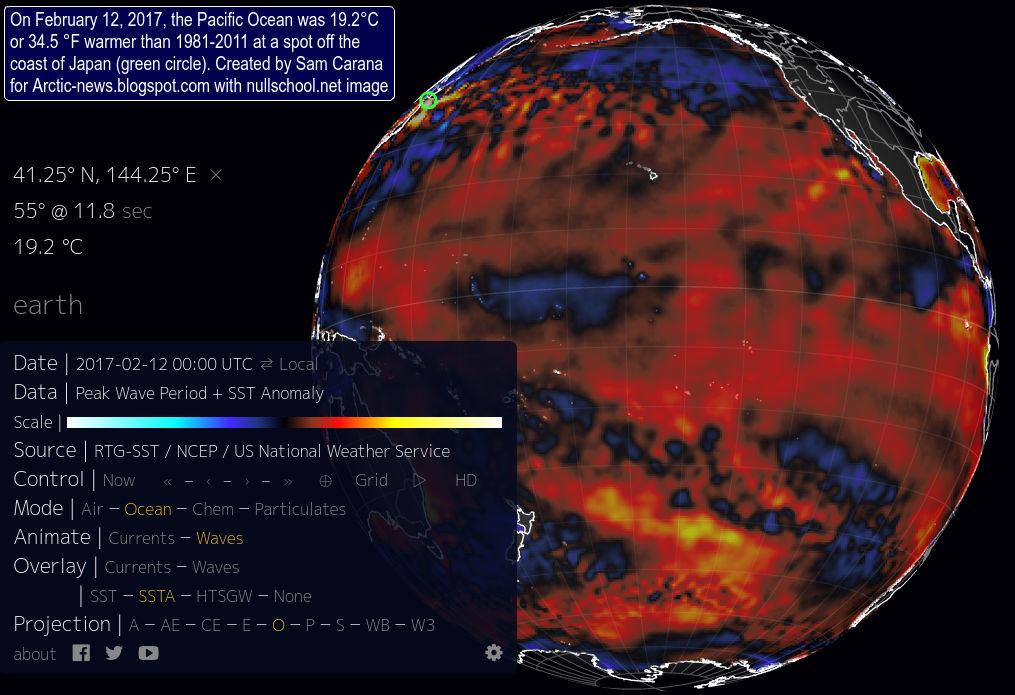
Above image shows temperature anomalies over the Pacific Ocean on February 12, 2017. Note the 19.2°C (34.5 °F) anomaly off the coast of Japan, at the location marked by the green circle.

In 2016, the annually-averaged temperature for ocean surfaces around the world was 0.75°C (1.35°F) higher than the 20th century average, higher than the previous record of 2015, NOAA reports. The global annual land surface temperature for 2016 was 1.43°C (2.57°F) above the 20th century average, surpassing the previous record of 2015 by 0.11°C (0.19°F). Note that NOAA uses the the 20th century average as a baseline, for more on different baselines, see this earlier post.

There is more heat on the way, as illustrated by the image below.


As above image shows, the El Niño-Southern Oscillation (ENSO) temporarily raises (El Niño) or suppresses (La Niña) global temperatures. Generally, the stronger the event (El Niño or La Niña), the greater its impact on the average global temperature around that time. Note that one value for 2016 literally went off the chart.


As above image shows (at the end of the graph on the right), we’ve barely had a bit of a La Niña in 2017 and we’re already facing another El Niño event.

[ click on images to enlarge ]

Above images shows ECMWF (European Centre for Medium-Range Weather Forecasts) plumes with strong positive anomalies in all three El Niño regions (on the right).

In other words, temperatures in 2017 look set to be very high, which spells bad news for the Arctic where temperature anomalies are already several times higher than in the rest of the world, as illustrated by the image below.

As the image below shows, Antarctic sea ice extent was at a record low for the time of the year on February 11, 2017.


The situation looks particularly grim for the Arctic sea ice. As the image below shows, Arctic sea ice extent on February 11, 2017, was also at a record low for the time of the year. In fact, it had fallen to 13,895,00 km² that day, raising the question whether perhaps the maximum for the year 2017 had already been reached.


Low global sea ice extent means that less sunlight is reflected back into space by the ice and that more heat is instead absorbed by the ocean, adding to the predicament the world is in. The situation in the Arctic is crucial, as huge amounts of methane, contained in sediments under the Arctic Ocean, could be released if warming continues, potentially triggering mass extinction of species, including humans, within one decade.

The situation is dire and calls for comprehensive and effective action as described in the Climate Plan.


Links


• Climate Plan
http://arctic-news.blogspot.com/p/climateplan.html

• Extinction
http://arctic-news.blogspot.com/p/extinction.html

• How much warming have humans caused?
http://arctic-news.blogspot.com/2016/05/how-much-warming-have-humans-caused.html

• Warning of mass extinction of species, including humans, within one decade
http://arctic-news.blogspot.com/2017/02/warning-of-mass-extinction-of-species-including-humans-within-one-decade.html


Read more ...

Monday, 9 January 2017

Canadian Arctic Archipelago Hit By M5.8 Earthquake

An earthquake with a magnitude of 5.8 on the Richter scale hit the Canadian Arctic Archipelago on January 8, 2017.


Above image was created with USGS (United States Geological Survey) content. The image shows the epicenter of the quake (gold star). The earthquake hit Barrow Strait on January 8, 2017 at 23:47:12 (UTC), at 74.320°N - 92.305°W and at a depth of 18.9 km.

Another earthquake hit Barrow Strait on January 9, 2017, this time with a magnitude of 5.2 on the Richter scale, within a day of the earlier M5.8 quake (both in orange on map below). These two earthquakes are among the largest quakes to hit the area in the past five years (map area shows all M1+ quakes since January 9, 2012).


These earthquakes are important, given their magnitude and given that they hit an area without large faultlines (though earthquakes are not uncommon here, also see this discussion). Importantly, these earthquakes occurred in an area prone to glacial isostatic adjustment, as illustrated by the image below.

From “http://grace.jpl.nasa.gov”, (unfiltered version). Credit: A, G., J. Wahr, and S. Zhong (2013) “Computations
of the viscoelastic response of a 3-D compressible Earth to surface loading: an application to Glacial Isostatic
Adjustment in Antarctica and Canada”, Geophys. J. Int., 192, 557–572, doi: 10.1093/gji/ggs030

Glacial isostatic adjustment as a phenomenon typically takes place over relatively long periods. Yet, extreme weather events can trigger earthquakes in areas that are already on the edge.

The extreme weather situation is depicted by the combination image below.


Similar to the M4.6 earthquake that hit Baffin Island on February 12, 2015, this earthquake occurred at a time when surface temperature anomalies over parts of North America and Greenland were at the bottom end of the scale. At the same time, temperature anomalies over the Arctic Ocean are at the top end of the scale, as illustrated by the left panel in above image. The right panel in above image shows pressure differences reaching the top and bottom ends of the scale.

Earthquakes in the Arctic Ocean are dangerous as they can destabilize methane hydrates. Huge amounts of methane are present in sediments under the Arctic Ocean in the form of free gas and hydrates. Earthquakes can send out strong tremors through the sediment and shockwaves through the water, which can trigger further earthquakes, landslides and destabilization of methane hydrates. The situation is especially dangerous when combined with extreme weather events that can cause cracks and movement in sediments.


Above map, from an earlier post, shows the location of fault lines on the Northern Hemisphere.

The combination image below shows methane levels on January 9, 2017, am, at two different altitudes.

[ click on images to enlarge ]

As temperatures in the Arctic Ocean keep rising, the jet streams and polar vortex are changing their shapes. The North Polar Jet Stream becomes more wavy, and this makes that more extreme weather events can happen such as the events described above.

The situation is dire and calls for comprehensive and effective action, as described at the Climate Plan.


Links

• Climate Plan
http://arctic-news.blogspot.com/p/climateplan.html

• Seafloor Methane
http://arctic-news.blogspot.com/2016/12/seafloor-methane.html

• High Methane Levels Follow Earthquake in Arctic Ocean
http://arctic-news.blogspot.com/2016/07/high-methane-levels-follow-earthquake-in-arctic-ocean.html

• Something had to give - Baffin Island hit by M4.6 earthquake
http://arctic-news.blogspot.com/2015/02/something-had-to-give-baffin-island-hit-by-m4.6-earthquake.html

• Ring Of Ice
http://arctic-news.blogspot.com/2014/08/ring-of-ice.html

• High Methane Levels over Laptev Sea
http://arctic-news.blogspot.com/2013/10/high-methane-levels-over-laptev-sea.html

• Methane Release caused by Earthquakes
http://arctic-news.blogspot.com/2013/09/methane-release-caused-by-earthquakes.html

• Sea of Okhotsk
http://methane-hydrates.blogspot.com/2013/06/sea-of-okhotsk.html


Read more ...

Wednesday, 21 December 2016

Lake Baikal

The amount of methane stored in the form of hydrates at the bottom of Lake Baikal in Siberia is an estimated 1 trillion m³, which translates into 424 trillion kg of methane, or 424 Gt of methane. By comparison, the amount of methane in the atmosphere is about 5 Gt.


Aral Sea
Methane hydrates remain stable under a combination of sufficiently low temperatures and sufficiently high pressure. The temperature of the water at the bottom of the lake is about 3.5°C. This means that a large amount of water needs to remain present in the lake at any time, in order to keep the methane hydrates stable.

Lake Baikal is the world’s deepest lake. Due to its depth, Lake Baikal is also the largest freshwater lake by volume in the world, containing roughly 20% of the world’s unfrozen surface fresh water. Lake Baikal has 23,615.39 km³ (5,700 cu mi) of fresh water and a maximum depth of 1,642 m (5,387 ft).

If the water level in Lake Baikal were to fall, the pressure on the methane hydrates would decrease, resulting in huge methane eruptions, dwarfing the amount of methane currently in the atmosphere.

What are the chances that water levels in Lake Baikal will fall in future? The above animation shows the fate of the Aral Sea, further to the west in Asia (also on the map at top). The Aral Sea virtually disappeared over the course of the last few decades. Some people point at climate change as the cause. More people point at irrigation by farmers.
Yenisei River

Lake Baikal could go the same way. Climate change may well reduce the flow of the rivers that now feed Lake Baikal from Mongolia (image right). Furthermore, climate change may well reduce crop yields worldwide as well as the availability of fresh water, increasing temptations to use the water of Lake Baikal for irrigation.

Further decline of Arctic sea ice is likely to push up temperatures across Russia. The image below shows that temperatures as high as 36.6°C or 97.8°F were forecast for June 13, 2016, over the Yenisei River in Siberia that ends in the Arctic Ocean.
[ click on images to enlarge or go to original post ]
Even higher temperatures were recorded in 2015 at a location in Siberia well within the Arctic Circle.

Demands for water could increase even more dramatically due to wildfires and the need to fight such fires. The image below shows that on June 23, 2016, wildfires north of Lake Baikal caused emissions as high as 22,953 ppb CO and 549 ppm CO₂ at the location marked by the green circle.

[ click on images to enlarge or go to original post ]
The situation is dire and calls for comprehensive and effective action, as described at the Climate Plan.


Links

 Climate Plan
http://arctic-news.blogspot.com/p/climateplan.html

 Gone: endemic Baikal sponge has died completely in several areas of the vast lake
http://siberiantimes.com/ecology/casestudy/features/f0278-gone-endemic-baikal-sponge-has-died-completely-in-several-areas-of-the-vast-lake/

 Volume to weight conversion
http://www.aqua-calc.com/calculate/volume-to-weight

 Lake Baikal, Wikipedia
https://en.wikipedia.org/wiki/Lake_Baikal

 Aral Sea, Wikipedia
https://en.wikipedia.org/wiki/Aral_Sea

 Climate Feedbacks Start To Kick In More
http://arctic-news.blogspot.com/2016/06/climate-feebacks-start-to-kick-in-more.html

 High Temperatures In Arctic
http://arctic-news.blogspot.com/2016/06/high-temperatures-in-arctic.html

 East Siberian Heat Wave
http://arctic-news.blogspot.com/2015/07/east-siberian-heat-wave.html

 Wildfires in Russia’s Far East
http://arctic-news.blogspot.com/2016/08/wildfires-in-russias-far-east.html


Read more ...

Monday, 12 December 2016

Seafloor Methane


Methane levels over the Arctic Ocean are higher than elsewhere on Earth. As the animation below shows, methane levels were as high as 2436 parts per billion (ppb) on the afternoon of December 5, 2016, with most methane rising up from the water, in particular over the Arctic Ocean.

Rise in the atmosphere of methane on December 5, 2016 (MetOp 1 pm), from 1000 mb, i.e. close to
sea level, up to a pressure of 586 mb, which corresponds with an altitude of 3833 m.

Methane levels over the Arctic Ocean have been high for more than a month. The video below, with a soundtrack by Daniel Kieve, shows methane levels from October 26, 2016 to November 25, 2016.


&nbsp

These high methane levels come at a time when there’s hardly any sunlight reaching the Arctic, which pretty much rules out the possibility that algae blooms or other biological sources were causing these high methane levels. Instead, these high methane levels appear to be the result of methane eruptions from the seafloor of the Arctic Ocean, caused by warming water of the oceans.


Indeed, large quantities of methane appear to be erupting from seafloor of the Arctic Ocean and, as this methane rises in the atmosphere, it moves closer to the Equator, resulting in higher methane levels there as well. Above image further illustrates that seafloor methane appears to be pushing up mean global methane level at higher altitudes.

The image below shows the temperature rise of the oceans. Temperatures are rising particularly rapidly on the Northern Hemisphere.

[ Ocean warming, from earlier post ]
The huge amounts of energy entering the oceans translate into higher temperatures of the water and of the air over the water, as well as higher waves and stronger winds. Much of that heat is carried by the Coriolis force along the Gulf Stream from the coast of North America via the North Atlantic into the Arctic Ocean.

As the image on the right shows, sea surface temperatures near Svalbard (green circle) were as high as 14.1°C / 57.3°F on December 6, 2016, 12.1°C / 21.7°F warmer than in 1981-2011.

The rise in ocean heat is threatening to cause ever larger eruptions of methane from the seafloor.

As described at the Extinction page, methane eruptions from the seafloor could well cause a 1.1°C temperature rise over the next ten years, and in combination with other elements, this is threatening to cause global temperature to rise 10°C or 18°F by 2026.

The situation is dire and calls for comprehensive and effective action as described in the Climate Plan.


Links

• A pdf of the extinction page and an introduction to the Climate Plan can be downloaded from
https://sites.google.com/site/samcarana/climateplan/Climate-Plan-by-Sam-Carana.pdf?attredirects=0&d=1

 Climate Plan
https://arctic-news.blogspot.com/p/climateplan.html

 Methane
https://arctic-news.blogspot.com/p/methane.html

 Extinction
https://arctic-news.blogspot.com/p/extinction.html

 Old Mother Nature, by Daniel Kieve
https://soundcloud.com/danielkieve/old-mother-nature


Read more ...

Friday, 4 November 2016

Less sea ice, warmer Arctic Ocean

On November 2, 2016, Arctic sea ice extent was at a record low for the time of the year, i.e. only 7.151 million km².

The currently very low sea ice extent is further dragging down the average annual sea ice extent, which is also at a record low, as illustrated by the image below, from the blog by Torstein Viðdalr.


Not only is Arctic sea ice extent very low, the sea ice is getting thinner and thinner, as illustrated by the image below, by Wipneus, showing the dramatic recent decline of Arctic sea ice thickness.
As the Naval Research Lab 30-day animation below shows, Arctic sea ice isn’t getting much thicker, despite the change of seasons.

Naval Research Lab 30-day animation (new model) up to Nov 1, 2016, with forecast up to Nov 9, 2016
In the two videos below, Paul Beckwith further explains the situation.


Paul Beckwith: “Arctic sea ice regrowth is eff’d this year, in fact is truly horrible. As the ice extent, defined as regions with at least 15% ice, tries to expand via sea water freezing, it is melted out by extremely high sea surface temperatures. Then the cooled surface water mixes via wave action with warmer water down to as much as 200 meters and the warm mixtures at the surface continue the process of sea ice melting. Without strong ice regrowth, we will reach the state we are heading to. Namely, zero sea ice. We must break this vicious cycle, by declaring a global climate emergency, and implementing the three-legged-stool solution set.”


As global warming raises the temperature of the sea surface and the atmosphere over the sea surface, ever stronger winds develop, in turn resulting in stronger waves and higher amounts of water in clouds.

The image below shows forecasts for November 9, 2016, of waves as high as 13.76 m (green circle, left panel) and of total amounts of water (from surface to space) as much as 1.38 kg/m² (green circle right panel, near Novaya Zemlya).

[ click on images to enlarge ]
High waves make it hard for sea ice to form, while greater evaporation from warmer oceans adds more water vapor to the atmosphere. More water vapor in the atmosphere results more precipitation. Rain can devastate the sea ice, as discussed in an earlier post. Furthermore, snow can inhibit formation of thicker is, as David Barber explains. Also, being a potent greenhouse gas, water vapor will further accelerate warming of the Arctic.

The dire state of the sea ice indicates that the water of the Arctic Ocean is getting warmer and warmer.


On October 31, 2016, the Arctic Ocean was as warm as 17°C or 62.7°F (green circle near Svalbard), or 13.9°C or 25°F warmer than 1981-2011. This indicates how much warmer the water is beneath the surface, as it arrives in the Arctic Ocean from the Atlantic Ocean.

Below is an update of the situation on methane. Contained in existing data is a trend indicating that methane levels could increase by a third by 2030 and could almost double by 2040.


Why is methane so important? On a 10-year timescale, methane causes more warming than carbon dioxide. Unlike carbon dioxide, methane’s Global Warming Potential rises as more of it is released. Methane’s lifetime can be extended to decades, in particular due to depletion of hydroxyl in the atmosphere.


Ominously, the image below shows that on November 9, 2016, methane levels were very high over the Laptev Sea (solid magenta color north of Siberia). 

The image below shows that methane levels on November 9, 2016, were as high as 2633 parts per billion (at a slightly higher altitude corresponding to a pressure of 469 mb). 
Temperatures over the Arctic Ocean are forecast to remain high, reflecting the very high temperature of the water.


The danger is that, as global warming continues and as the Arctic snow and ice cover keeps shrinking, warming of the Arctic Ocean will speed up and destabilize methane hydrates contained in sediments at its seafloor, triggering huge methane eruptions that will further accelerate warming. This could contribute to make global temperature rise by as much as 10°C or 18°F over the coming decade.

The situation is dire and calls for comprehensive and effective action, as described in the Climate Plan.


Read more ...

Monday, 10 October 2016

Blue Ocean Event September 2017?

Will there be a Blue Ocean Event in September 2017, during which the Arctic Ocean will be virtually ice-free? What would be the significance of such an event?

The Arctic Ocean is about to become virtually ice-free, perhaps as early as next year. At first, this Blue Ocean Event may last for one or more days in September 2017. Over the years, the ice-free period will grow longer and longer, if no action is taken.

Projections of an ice-free Arctic Ocean have been made for years. What makes the prospect of a Blue Ocean Event so dire?

Disappearance of the sea ice means that a huge amount of sunlight that was previously reflected back into space, is instead getting absorbed by the Arctic. The reason for this is that sea ice is more reflective than the water of the Arctic Ocean. The situation on land in the Arctic is similar, i.e. the snow and ice cover on land is more reflective than the darker soil and rocks that get uncovered as the snow and ice disappears. So, extra heat gets added and this is accelerating warming in the Arctic. On land, extra heat will also warm up water of rivers, and a lot of this heat will end up in the Arctic Ocean.

Another feedback is water vapor, as highlighted in the diagram below.


A warmer atmosphere carries more water vapor. Since water vapor is a potent greenhouse gas, this further accelerates warming over the Arctic.


As above image shows, temperatures have been more than 2.5°C warmer than 1981-2010 over most of the Arctic Ocean over the past 365 days (up to October 7, 2016). Accelerated Arctic warming has been taking place for a long time. So, what is it that makes a Blue Ocean Event, a virtually ice-free Arctic Ocean, such a big thing?

It is a huge event, because once the sea ice is gone, warming of the Arctic Ocean is likely to speed up even more dramatically. Why? Because having no more sea ice means that the buffer is gone. In the past, thick sea ice extended meters below the sea surface, in many parts of the Arctic Ocean. Melting of this ice into water did consume massive amounts of ocean heat. As such, thick sea ice acted as a buffer. Over the years, Arctic sea ice has become thinner and thinner, as illustrated by the image below.

[ click on image to enlarge ]
Over the past few years, trends have been pointing at zero thickness soon, i.e. in a matter of years. Added below is a trend produced by Arctische Pinguin, pointing at zero volume sea ice in the year 2021.
[ click on image to enlarge ]
Note that there is some variability from year to year. This indicates that a Blue Ocean Event may well happen earlier than the trend, e.g. in September 2017. The image further shows that there’s hardly any buffer left, the buffer is virtually gone!

This buffer used to consume massive amounts of ocean heat that is carried along sea currents into the Arctic Ocean. Once the sea ice is gone, that heat must go somewhere else. A huge amount of energy used to be absorbed by this buffer, i.e. by melting ice and transforming it into water. The energy that used to be absorbed by melting ice is as much as it takes to warm up an equivalent mass of water from zero °C to 80 °C. Much of this heat will then suddenly speed up warming of the water of the Arctic Ocean, rather than going into melting the ice as it did previously. So, the water of the Arctic Ocean will suddenly warm up dramatically. Remember that the Arctic Ocean in many areas is very shallow, in many places it’s less than 50 m deep, as discussed in an earlier post.

The Buffer has gone, feedback #14 on the Feedbacks page
The danger is that this extra heat will reach the seafloor and destabilize methane hydrates that are contained in sediments at the bottom of the Arctic Ocean. This could result in huge methane eruptions. It is hard for methane plumes to get broken down in the water, given the abrupt and concentrated nature of such releases and given that the Arctic Ocean is in so many places very shallow. Once that methane enters the atmosphere, it will strongly contribute to further warming of the atmosphere over the Arctic.


In conclusion, disappearance of the sea ice would mean that the buffer has gone. This further increases the danger of huge abrupt releases of methane from the seafloor of the Arctic Ocean. In many respects, the danger is such that we can just count ourselves lucky that such huge releases haven’t occurred yet.

In response to this danger, comprehensive and effective action is needed, along multiple lines of action, each implemented in parallel and simultaneously. While local feebates are typically the most effective policies, local communities can each decide what works best for them, provided that agreed targets are met, and such targets will need to be a lot stronger and more comprehensive than the aspirational emission reductions that countries have submitted as part of the Paris Agreement.

The situation is dire and calls for comprehensive and effective action, as described in the Climate Plan.


Above post was also read by David Petraitis as part of the podcast by Wolfgang Werminghausen


Read more ...
Designed By Published.. Blogger Templates