Breaking News
Showing posts with label extinction. Show all posts

Wednesday, 8 February 2017

Warning of mass extinction of species, including humans, within one decade


[ click on images to enlarge ]
On February 10, 2017, 18:00 UTC it is forecast to be 0.1°C or 32.1°F at the North Pole, i.e. above the temperature at which water freezes. The temperature at the North Pole is forecast to be 30°C or 54°F warmer than 1979-2000, on Feb 10, 2017, 18:00 UTC, as shown on the Climate Reanalyzer image on the right.

This high temperature is expected as a result of strong winds blowing warm air from the North Atlantic into the Arctic.

The forecast below, run on February 4, 2017, shows that winds as fast as 157 km/h or 98 mph were expected to hit the North Atlantic on February 6, 2017, 06:00 UTC, producing waves as high as 16.34 m or 53.6 ft.


A later forecast shows waves as high as 17.18 m or 54.6 ft, as illustrated by the image below.


While the actual wave height and wind speed may not turn out to be as extreme as such forecasts, the images do illustrate the horrific amounts of energy contained in these storms.

Stronger storms go hand in hand with warmer oceans. The image below shows that on February 4, 2017, at a spot off the coast of Japan marked by green circle, the ocean was 19.1°C or 34.4°F warmer than 1981-2011.


As discussed in an earlier post, the decreasing difference in temperature between the Equator and the North Pole causes changes to the jet stream, in turn causing warmer air and warmer water to get pushed from the North Atlantic into the Arctic.

The image below shows that on February 9, 2017, the water at a spot near Svalbard (marked by the green circle) was 13°C or 55.3°F, i.e. 12.1°C or 21.7°F warmer than 1981-2011.

[ click on images to enlarge ]
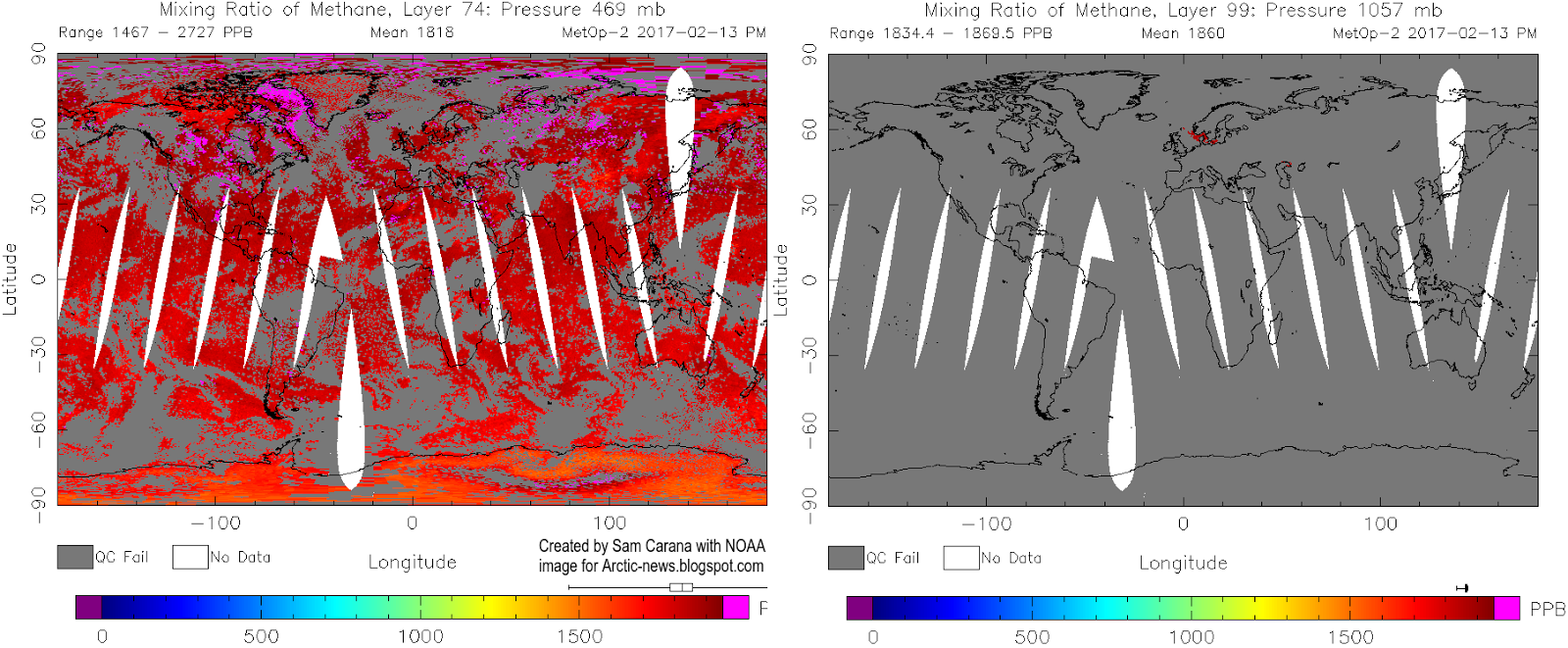
Warmer water flowing into the Arctic Ocean in turn increases the strength of feedbacks that are accelerating warming in the Arctic. One of these feedbacks is methane that is getting released from the seafloor of the Arctic Ocean. Update: The image below shows that methane levels on February 13, 2017, pm, were as high as 2727 ppb, 1½ times the global mean at the time.

[ click on image to enlarge, right image added for reference to show location of continents ] 
What caused such a high level? High methane levels (magenta color) over Baffin Bay are an indication of a lot of methane getting released north of Greenland and subsequently getting pushed along the exit current through Nares Strait (see map below). This analysis is supported by the images below, showing high methane levels north of Greenland on the morning of February the 14th (left) and the 15th (right).


The image below shows methane levels as high as 2569 ppb on February 17, 2017. This is an indication of ocean heat further destabilizing permafrost at the seafloor of the Laptev Sea, resulting in high methane concentrations where it is rising in plumes over the Laptev Sea (at 87 mb, left panel) and is spreading over a larger area (at slightly lower concentrations) at higher altitude (74 mb, right panel).


This illustrates how increased inflow of warm water from the North Atlantic into the Arctic Ocean can cause methane to erupt from the seafloor of the Arctic Ocean. Methane releases from the seafloor of the Arctic Ocean have the potential to rapidly and strongly accelerate warming in the Arctic and speed up further feedbacks, raising global temperature with catastrophic consequences in a matter of years. Altogether, these feedbacks and further warming elements could trigger a huge abrupt rise in global temperature making that extinction of many species, including humans, could be less than one decade away.


Without action, we are facing extinction at unprecedented scale. In many respects, we are already in the sixth mass extinction of Earth’s history. Up to 96% of all marine species and 70% of terrestrial vertebrate species became extinct when temperatures rose by 8°C (14°F) during the Permian-Triassic extinction, or the Great Dying, 252 million years ago.

During the Palaeocene–Eocene Thermal Maximum (PETM), which occurred 55 million years ago, global temperatures rose as rapidly as by 5°C in ~13 years, according to a study by Wright et al. A recent study by researchers led by Zebee concludes that the present anthropogenic carbon release rate is unprecedented during the past 66 million years. Back in history, the highest carbon release rates of the past 66 million years occurred during the PETM. Yet, the maximum sustained PETM carbon release rate was less than 1.1 Pg C per year, the study by Zebee et al. found. By contrast, a recent annual carbon release rate from anthropogenic sources was ~10 Pg C (2014). The study by Zebee et al. therefore concludes that future ecosystem disruptions are likely to exceed the - by comparison - relatively limited extinctions observed at the PETM.

An earlier study by researchers led by De Vos had already concluded that current extinction rates are 1,000 times higher than natural background rates of extinction and future rates are likely to be 10,000 times higher.

from the post 2016 well above 1.5°C
As above image shows, a number of warming elements adds up to a potential warming of 10°C (18°F) from pre-industrial by the year 2026, i.e. within about nine years from now, as discussed in more detail at the extinction page.


Above image shows how a 10°C (18°F) temperature rise from preindustrial could be completed within a decade.

https://sites.google.com/site/samcarana/climateplan
The situation is dire and calls for comprehensive and effective action, as discussed in the Climate Plan.


Links

• Climate Plan
http://arctic-news.blogspot.com/p/climateplan.html

• Arctic Ocean Feedbacks
http://arctic-news.blogspot.com/2017/01/arctic-ocean-feedbacks.html

• Extinction
http://arctic-news.blogspot.com/p/extinction.html

• How much warming have humans caused?
http://arctic-news.blogspot.com/2016/05/how-much-warming-have-humans-caused.html

• Estimating the normal background rate of species extinction, De Vos et al. (2015)
https://www.ncbi.nlm.nih.gov/pubmed/25159086

• Anthropogenic carbon release rate unprecedented during the past 66 million years, by Zebee et al. (2016)
http://www.nature.com/ngeo/journal/v9/n4/full/ngeo2681.html

• Evidence for a rapid release of carbon at the Paleocene-Eocene thermal maximum, Wright et al. (2013)
http://www.pnas.org/content/110/40/15908.full?sid=58b79a3f-8a05-485b-8051-481809c87076

• RT America Youtube video
https://www.youtube.com/watch?v=OSnrDRU6_2g

• RT America Facebook video
https://www.facebook.com/RTAmerica/videos/10154168391051366


Warning of mass extinction of species, including humans, within one decade. The forecast for February 10, 2017, 18:00 UTC is that it will be 32.1°F or 0.1°C on North Pole, i.e. above freezing…
Posted by Sam Carana on Wednesday, February 8, 2017
Read more ...

Sunday, 20 September 2015

August 2015 Had Highest Sea Surface Temperature on Record

Across the oceans, the August 2015 globally-averaged sea surface temperature was 0.78°C (1.40°F) above the 20th century average—the highest temperature for any month in the 1880–2015 record. NOAA analysis further shows that in August 2015, the sea surface on the Northern Hemisphere was 1.02°C (1.84°F) warmer than it was in the 20th century, as illustrated by the graph below.


As the image below shows, the August data for sea surface temperature anomalies on the Northern Hemisphere contain a trendline pointing at a rise of 2°C (3.6°F) well before the year 2030. In other words, if this trend continues, the Northern Hemisphere sea surface will be 2°C (3.6°F) warmer in about a dozen years time from now.


Such a temperature rise would be catastrophic, as there are huge amounts of methane contained in the form of hydrates and free gas in sediments under the Arctic Ocean seafloor. A relatively small temperature rise of part of these sediments could cause a huge abrupt methane eruption, further speeding up local warming and triggering further methane eruptions, in a spiral of runaway warming that will cause mass destruction and extinction, as described in the reference page The Mechanism.

The situation is dire and calls for comprehensive and effective action, as discussed at the Climate Plan page.


August data for sea surface temperature anomalies on the Northern Hemisphere contain a trendline pointing at a rise of 2…

Posted by Sam Carana on Sunday, September 20, 2015
Read more ...

Saturday, 5 September 2015

Methane Monster II ~ Demise of the Arctic


Presentation by Jennifer Hynes on runaway feedbacks in the Arctic and the resulting threat of near-term human extinction. At youtube.com/watch?t=309&v=L19JBY0kNmo


There are links to the transcript and to the complete set of slides of the presentation at Jennifer Hynes’ blog.

In case you are looking for the earlier presentation by Jennifer Hynes, called ‘The Arctic Methane Monster’s Rapid Rise’, it’s at youtube.com/watch?v=a9PshoYtoxo and is also displayed below.


Read more ...

Tuesday, 10 March 2015

September 2015 without Arctic Sea Ice?

The image below shows that Arctic sea ice extent, on March 8, 2015, was merely 14.263 square km.


What would happen if the Arctic sea ice kept falling to, say, under 11 million square km by end April and then followed a trajectory similar to 2012 for the next four months? As the animation below shows, such a scenario could wipe out all Arctic sea ice for more than a month from September 1st, 2015.

The following image is a contribution by Albert Kallio.

Sea ice thickness image, Naval Reserach Laboratory
Albert Kallio comments: “The latest sea ice thickness measurement (9th March 2015) for the US Navy submarines shows that the thick and rigid multiyear sea ice congestion has cleared from the Fram Strait between Greenland and the Svalbard Archipelago. That means sea ice is weak; new ice with saline residues and pack ice is made of numerous thin sea ice slabs that have been compressed to thick piles, rather than fewer thick slabs of multiyear sea ice. That means: more sea ice surface area is exposed to sea water and the heat within it. As a result, sea ice is likely melt even faster once it escapes from the Fram Strait. The wave penetration is also stronger within soft and highly fragmented seasonal ice packs. So, the sea ice is now primed for faster transport out of the Arctic Ocean.”

So, what would happen if the sea ice was wiped out like that?

Sunlight that previously went into melting the sea ice, as well as sunlight that was previously reflected back into space by sea ice, would be absorbed by the Arctic Ocean instead. In other words, we can expect massive warming. In an earlier post, Prof. Peter Wadhams warned that warming due to Arctic snow and ice loss may well exceed 2 W per square m, i.e. it could more than double the net warming causing by all emissions by all people of the world.

Professor Peter Wadhams on albedo changes in the Arctic
The resulting temperature rise is likely to start wildfires all over the Northern Hemisphere, which would not only send huge amounts of greenhouse gases and soot into the air, but could also threaten entire cities and cause much of the grid to stop functioning. In 2007, a main power line burnt in Australia causing power outages for many homes and traffic lights in Melbourne. Many power plants require extensive water cooling, which can come under threat during intense heatwaves, as happened in France in 2009. Such events may be dwarfed by future heatwaves. Fuel is often transported by rail to power plants, and the railway tracks could bend during heatwaves. The health threat posed by heatwaves, wildfires and soot may result in critical employee loss at power plants.

As a result, electricity supply could stutter, and much industrial activity may stop, while there may be lots of traffic problems, etc. This is only one of the problems, though, as discussed in the 2007 post Ten Dangers of Global Warming. Food supply will come under threat due to crop loss and reduced supply of food to shops, made worse by traffic problems. As discussed back in 2011, much of the soot from firestorms in Siberia could settle on the ice in the Himalaya Tibetan plateau, melting the glaciers there and causing short-term flooding followed by rapid decrease of the flow of ten of Asia’s largest river systems that originate there, with more than a billion people’s livelihoods depending on the continued flow of this water.

Less industrial activity will not cause an immediate fall of tenmperatures, though. Instead, it would make that the aerosols that are currently sent up in the air by such activities and that are currently masking the full wrath of global warming, will fall out of the air in a matter of weeks. Until now, about half of the global temperature rise is suppressed by such aerosols. Stopping aerosols release overnight could make temperatures rise abruptly by 1.2°C (2.16°F) in a matter of weeks.


Methane eruptions from the seafloor of the Arctic Ocean typically start becoming huge around the end of October.

Conclusion from a paper presented at the 2008 EGU conference, on background
of a frame from a video interview by Nick Breeze with Natalia Shakhova.

Further warming of the Arctic Ocean could cause methane to erupt from the seafloor of the Arctic Ocean in quantities that could quickly double and tripple the amount of methane in the atmosphere.

The combined impact of such feedbacks could wipe out crops, deplete water supplies and make a huge number of species go extinct very quickly, including human beings.

In conclusion, the situation is dire and calls for comprehensive and effective action, as discussed at the Climate Plan blog.


Read more ...

Tuesday, 27 January 2015

Andrew Harvey Interviews Guy McPherson


Andrew Harvey, founder & director of the Institute for Sacred Activism, interviews Dr. Guy McPherson on the topic of how to live with death in mind. Harvey reads excerpts from his foreword in Dr. McPherson and Carolyn Baker’s new book, ’Extinction Dialogs: How to Live With Death in Mind’.


Links

Follow Guy McPherson’s European Trip March/April 2015
https://www.facebook.com/pages/Guy-McPherson-European-Trip-MarchApril-2015/1381860682059663

Nature Bats Last at Youtube
https://www.youtube.com/channel/UCyerZPyOwZdwRQtV66L6VTA

Andrew Harvey
http://www.andrewharvey.net

Guy McPherson
http://guymcpherson.com

Interview with Andrew Harvey
Read more ...

Monday, 5 May 2014

Will the Anthropocene last for only 100 years?

On November 9, 2013, methane levels as high as 2662 ppb (parts per billion) were recorded, as indicated by the red dot on the image below.


This image, from an earlier post, gives an idea of the height of this level compared to historic methane levels, and how fast levels of methane (CH4) have been rising compared to levels of two other greenhouse gases, i.e. carbon dioxide (CO2) and nitrous oxide (N2O).

CO2 concentrations in the atmosphere have now risen to levels well above the 400 parts per million (ppm), as illustrated by the graph below, from keelingcurve.ucsd.edu. This 400 ppm is 143% the pre-industrial peak level of 280 ppm.

Paleorecords show that greenhouse gases levels go up and down in lockstep with temperatures in history. The image below shows that carbon dioxide levels back in history typically moved between approximately 180 ppm and 280 ppm, a difference of 100 ppm. Since 1950, CO2 levels have risen by roughly the same difference.


In a fascinating lecture, Dr Jan Zalasiewicz suggests that the Anthropocene started around 1950, when levels of greenhouse gases started to rise exponentially, in line with the rise of fossil fuel use, as also illustrated by the image below.


The image below, from an earlier post, shows that temperatures typically moved up and down by roughly 10 degrees Celsius between a glacial and interglacial phase of the ice ages, suggesting that a 100 ppm rise of carbon dioxide and 300 ppb rise of methane go hand in hand with a 10°C temperature rise.

Many eminent scientists have warned that the high current carbon dioxide levels have already locked us in for a future temperature rise of several degrees Celsius, a rise that is yet to fully manifest itself and that is only held off by the temporary masking effect of sulfur dioxide that is emitted when burning fuel (especially coal) and by the (decreasing) capacity of oceans, ice sheets and glaciers to act as a buffer for heat. Once the masking effect of sulfur dioxide ends and the Arctic sea ice collapses, a huge sudden rise in temperature can be expected, hitting vulnerable pools (see image below) which would accelerate the temperature rise even more and could cause temperatures to rise by another 10°C within decades.


The scenario of such a huge rise in temperature becomes a distinct possibility when considering the combined warming impact of carbon dioxide, methane, nitrous oxide, water vapor and albedo changes, and the vulnerability of some of the terrestrial and marine carbon pools. Also note that, while the above Unesco image gives an estimate of 104 or 10,000 Gt C for ocean methane hydrates, several studies give even higher estimates, as illustrated by the image below, from Pinero et al.


The amount of carbon stored in hydrates globally was in 1992 estimated to be 10,000 Gt (USGS), while a later source gives a figure of 63,400 Gt C for the Klauda & Sandler (2005) estimate of marine hydrates. A warming Gulf Stream is causing methane eruptions off the North American coast. Furthermore, methane appears to be erupting from hydrates on Antarctica, on the Qinghai-Tibetan Plateau and on Greenland. In just one part of the Arctic Ocean alone, the East Siberian Arctic Shelf (ESAS), up to 1700 Gt of methane is contained in sediments in the form of methane hydrates and free gas. A sudden release of just 3% of this amount could add over 50 Gt of methane to the atmosphere, i.e. some seven times what is in the atmosphere now, and experts consider such an amount to be ready for release at any time.

Importantly, methane levels have risen even more strongly than carbon dioxide levels. As the image at the top of this post shows, the current methane level is 250% its pre-industrial peak level, i.e. 1100 ppb above the pre-industrial peak level of 700 ppb. Historically, methane has only moved by some 300 ppb between a glacial and interglacial phase of the ice ages. IPCC/NOAA figures suggest that global mean methane levels have been rising by 5 or 6 ppb annually over recent years and there are some worrying indications that the rise of methane levels might accelerate even further.

To obtain mean methane abundance, measurements are typically taken at an altitude of 586 mb, as methane typically shows up most prominently at this altitude. Indeed, mean methane levels were highest at this altitude in April 2013, at just under 1800 ppb. Looking at mean global methane levels in April 2014 at this altitude, one could at first glance conclude that the situation had not changed much, and that 2014 methane levels had merely risen by a few ppb, in line with IPCC data. So, at first glance one might conclude that there may appear to be only a minimal rise (if any at all) in global mean methane levels when taking measurements at lower altitudes.

The image below illustrates this. What should be added is that the analysis used only selected altitudes and only used part of all data. So, further analysis may be necessary to verify these findings.


Importantly, closer examination of above graph shows that the situation is dramatically different when looking at the rise in methane levels at higher altitudes. A huge rise in mean methane levels appears to have taken place, to the extent that the highest mean level is now reached at 469 mb. Overall, the average rise in methane across the altitudes that are highlighted in the image is no less than 16 ppb.

The table below shows the altitude equivalents in mb (millibar) and feet.
56925 feet44689 feet36850 feet30569 feet25543 feet19819 feet14383 feet8367 feet1916 feet
74 mb147 mb218 mb293 mb367 mb469 mb586 mb742 mb945 mb

As the image below illustrates, this rise appears to go hand in hand with much higher peak readings, especially at higher altitudes. It appears that the additional methane originates from the higher latitudes of the Northern Hemisphere and has over the past few months moved closer to the equator, which is what typically occurs as methane rises in altitude.


Peak readings in above image are averages over April. On specific days, peak readings could be much higher, e.g. on April 28, 2014, methane levels were recorded as high as 2551 ppb at 469 mb.

As said, there appears to be a 16 ppb rise when comparing global mean methane levels between April 2013 and April 2014. Indeed, the culprit appears to be the rapid rise of methane emissions from hydrates that has been documented by this blog and that I estimated to amount to 99 Tg annually, as illustrated by the image below, from an earlier post.


So, it appears that the rise of methane in the atmosphere is accelerating. What can we expect? As temperatures can be expected to continue to rise and as feedbacks start to kick in, this may well constitute a non-linear trend. The image below shows a polynomial trend that is contained in IPCC AR5 data from 1955 to 2011, so they didn’t include this recent steep rise. Nonetheless, the polynomial trendline points at methane reaching mean global levels higher than 3000 ppb by the year 2030. If methane starts to erupt in large quantities from clathrates underneath the seafloor of the Arctic Ocean, this may well be where we are heading.
So, how high could temperatures rise? Worryingly, a non-linear trend is also contained in the temperature data that NASA has gathered over the years, as described in an earlier post. A polynomial trendline points at global temperature anomalies of 5°C by 2060. Even worse, a polynomial trend for the Arctic shows temperature anomalies of 4°C by 2020, 7°C by 2030 and 11°C by 2040, threatening to cause major feedbacks to kick in, including albedo changes and methane releases that will trigger runaway global warming that looks set to eventually catch up with accelerated warming in the Arctic and result in global temperature anomalies of 20°C+ by 2050.


Without action, it appears that the Antropocene will lead to extinction of the very human beings after which the era is named, with the Anthropocene only running from 1950 to 2050, a mere 100 years and much too short to constitute an era. In that case a better name would be the Sixth Extiction Event, as also illustrated by the image below, from an earlier post.


In conclusion, it’s high time that we start acting as genuinely wise modern human beings and commit to comprehensive and effective action as discussed at the Climate Plan blog.


Read more ...

Monday, 4 November 2013

BREAKTHROUGH DOCUMENTARY EXPOSES SEVERE ARCTIC METHANE THREAT

by Gary Houser


BREAKTHROUGH DOCUMENTARY EXPOSES SEVERE ARCTIC METHANE THREAT:
Climate Movement Must Grasp Danger Beyond Human-Generated Carbon

“Last Hours expertly explains how we got here, and what will happen if we don’t work together to stop it. It is a needed and urgent call to action.”
— Former Vice-President Al Gore [1]
“In the 18th century, Edmund Burke wrote, ‘Those who don’t know history are destined to repeat it.’ Many years later, Last Hours makes clear how much we have to learn from our planet’s history to truly understand the potent threat of trapped methane.”
 Maggie Fox, President, Climate Reality Project (started by Al Gore) [2]
“It’s not clear that civilization could survive that extreme of a climate change.”
 world renowned climate scientist James Hansen, referring to the devastating level of global warming that could result from a major release of super greenhouse gas methane [3]
The climate movement has come a long way. Despite vociferous opposition from the wealthiest corporations on earth, it has refused to be relegated to the sideline and by sheer determination has forged a path into public consciousness. A major coalition has formed in opposition to the tar sands pipeline, and many good-hearted people are giving their all - including nonviolent civil disobedience - in spirited resistance. This writer is a part of that movement.

A Larger Carbon Threat Beyond Human-Generated Emissions -
It is absolutely necessary to continue the struggle to rein in human-generated emissions of carbon dioxide. But what has been missing in this movement is an awareness that these emissions are now on track to trigger a release of an even larger and more potent reservoir of greenhouse gases that has until now been locked in ice. This colossal stockpile of frozen ancient organic matter contains at least four times as much carbon as the sum total that has been released by human activity on the planet since the beginning of the industrial age. [4] As a significant portion is being stored in the form of methane - a super global warming gas that is a stunning 86 times more powerful than CO2 [5], scientists refer to this huge threat as a “sleeping giant”. If major amounts thaw and release into the atmosphere, global warming would accelerate to the crossing of a tipping point - whereby the process becomes a runaway train and there is no longer hope for human intervention.

The Role of Methane in Earth’s Mass Extinction Events -
Large scale methane release would speed all the worst impacts of climate disruption - severe drought, sea level rise, storms, flooding, wildfires, and forced migration of refugees - causing them to occur much sooner and on a more intense scale than currently projected. Some of that impact is described in an article published by the highly respected science journal Nature. [6] As if that level of devastation is not enough, it is even more disturbing is to contemplate where the crossing of this tipping point might lead. The prevailing opinion in the scientific community is that the release of super potent methane has played a central role in two of the most devastating mass extinction events in the history of earth - the End-Permian and the PETM. In the End-Permian, a mind-boggling 90 percent of all life forms on the planet were wiped out.

The scientific inquiry into the cause of this horrendous wipe-out has been portrayed in an under-publicized but extremely important documentary by the BBC entitled “The Day Earth Nearly Died”. [7] The “short version” is that a tremendous, unprecedented series of volcanic eruptions in Siberia released enough carbon dioxide to drive earth’s temperature up six degrees C (celsius). This radical increase then warmed the world’s polar regions enough to thaw previously frozen methane. Evidence points to the heat from this super global warming gas driving temperatures up another five degrees C and causing the horrific wipe-out.

fish skeleton on parched soil, credit: Will Sherman
An Imperative Need to Communicate the Danger -
Politically neutral global organizations such as the World Bank and the International Energy Agency (IEA) are vehemently warning that the world is already on track for a five degree C warming by the end of the century. [8] Human-generated emissions are now pushing as much carbon pollution into the atmosphere as the Siberian volcanoes. This begs the obvious and deeply troubling question: Is the stage being set for another massive release of nature’s own currently frozen carbon?

Methane plumes rising from the seafloor
Ominous Signs that Methane Thaw Is Already Starting -
As temperature increases are occuring more rapidly in the Arctic than anywhere on earth, the ice cover is now in a state of collapse from massive melting. It is widely known that in 2012 the record for ice loss was not just broken but shattered. As a result, that which has been called “permafrost” is no longer “permanent”. On land, the tundra soil is progressively thawing - releasing both CO2 and methane. Key researchers are warning that an irreversible tipping point could come as soon as 15 or 20 years. [9] Even worse, it appears that as the upper layer of tundra thaws and exposure to sunlight is increased, a chemical reaction is increasing the speed: “….sunlight increases bacterial conversion of exposed soil carbon into carbon dioxide gas by at least 40 percent compared to carbon that remains in the dark.” [10]

Vast amounts of of methane are also stored in frozen form in the seabeds. Whereas methane from the deep ocean oxidizes and is neutralized before it reaches the surface, the shallow seabeds along Arctic coastlines allow it to vent directly into the atmosphere. Russian researchers that have been monitoring the situation since the 1990s are now reporting “astonishment” at the vast scale of methane plumes being observed along the Siberian coast. Some of these plumes are a full kilometer wide - something never encountered before. [11] Other researchers from NASA are using aircraft to measure methane emissions entering the atmosphere and are reporting troubling increases. [12]

In other words, the date for a tipping point of no return has been moved up. The danger of climate disruption spinning out of human control is already staring us in the face.

A Breakthrough Documentary Finally Opening the Doors of Awareness -
It is imperative that this level of urgency be conveyed to government policymakers. For several years, a small but determined network of climate activists - backed by scientists engaged in cutting edge research - has been trying to sound the alarm about this catastrophic threat. Their efforts until now have largely been stymied by a combination of psychological denial regarding the severity of the danger, a seeming inability by the climate movement to look beyond the immediate battles regarding human-generated carbon emissions, and an almost paralyzing bureaucratic inertia within a scientific establishment failing to keep pace with the dizzying speed of climate disruption.

In this context, there has been a most welcome new development. Thanks to Thom Hartmann, Leila Conners and the Tree Media production group, a breakthrough documentary has been created which conveys this immense danger in no uncertain terms. [13] Solidly grounded on interviews with leading scientists and laced with visuals that drive the point home, “Last Hours” packs a big punch within the brief space of only 10 minutes.

This is the bullet point message on the home page of its website:
  • Underground, underwater and below the ice.
  • A time bomb is ticking.
  • Scientists are seeing the evidence.
  • Runaway climate change could be closer than we think. 
It is one of the first documentaries on climate that takes an unflinching look at the most colossal mass extinction events in the history of earth and points out how such devastation was related to severe climate change. It then looks at the tremendous level of climate disruption happening at the present time - which is occurring at a speed without any precedent in earth history, and refuses to shirk from using the same dreaded “e word” of extinction to describe the danger we face today.


Keystone XL Pipeline protest - photo taken Feb 13, 2013 - from: flickr.com/photos/tarsandsaction/ 
In response to this invaluable program, there are now very positive signs that this recognition is finally taking place. In addition to the strong endorsements at the beginning of this commentary by Al Gore and Maggie Fox, the leaders of two other key climate groups add their voices:
“Last Hours is a captivating, extremely compelling appeal meant to awaken politicians and business leaders to take climate change action and stop runaway catastrophic climate change. Few films have managed to capture the sense of urgency as well as Last Hours. In the context of science telling us that emissions need to peak by 2015 and then come down, and with politicians doing little to reflect this urgency, this is a much needed asset for the climate movement.” [14]
 Kumi Naidoo, International Director, Greenpeace International
“Last Hours is an alarming video that captures the state of emergency we face with climate disruption–yet at the same time we must recognize that there is real hope: the clean energy industry is rapidly growing, we are making headway in reducing carbon pollution, and by working together we can turn things around.” [15]
— Michael Brune, Executive Director, Sierra Club
A Threat Comparable to Nuclear War -
The threat to our society represented by nuclear war can be grasped through the dramatic imagery of an atomic fireball, its devastation instantaneous. The threat from a climate catastrophe is no less sweeping, but actually more insidious as it would be a slow motion holocaust. Its impacts will gradually encircle humanity until the trap is sprung, at which time there is no escape.

Lying in wait in the Arctic is a volume of carbon that could easily push global temperatures so high as to threaten all life on earth. The three word phrase “irreversible tipping point” is easy to say but immensely challenging to truly comprehend. It is the point when colossal natural forces take over, when human civilization is rendered a helpless witness to its own destruction - a moment in time with supremely profound moral implications.

Who stands up for the children? - screenshot from children against climate change protest video
“The eyes of the future are looking back at us and they are praying for us to see beyond our own time. They are kneeling with hands clasped that we might act with restraint, that we might leave room for the life that is destined to come." 
— Terry Tempest Williams [16]
A Prayer from the Future -
The author has written a more in depth commentary on the existential threat presented by methane and the failure until now by our society to come to terms with it. [17] But it is ultimately a point where words fail to do justice. How can one describe the un-surpassable tragedy of the entire precious gift of life on this planet being decimated before our very eyes? In the words of ecological ethicist David Orr: “Climate destabilization, like nuclear war, has the potential to destroy all human life on Earth and in effect murder the future’……Willfully caused extinction is a crime that as yet has no name.”

It is now clear that the thaw and release of the "carbon bomb” in the Arctic has begun and is expanding. It is not just about the tar sands pipeline and human-generated carbon pollution, it is the monstrous beast in the Arctic that could be triggered by these pollutants. The climate movement - which has now spread world-wide - is the last and only hope for our society. Its passion must be brought to bear on this over-arching danger, its eyes fully opened if humanity is to even have a chance to act before it is too late.

The reaction of some of the leadership of this movement to “Last Hours” is a sign of hope. But that recognition must be rapidly disseminated and integrated by the grassroots base. There is a compelling need for wide circulation of this documentary. We must all break through our natural denial regarding a threat of this magnitude and find the strength to face it. In the words of a poem entitled “Invocation” by John Seed:
“Fill us with a sense of immense time so that our brief, flickering lives may truly reflect the work
of vast ages past and also the millions of years of evolution whose potential lies in our trembling hands.” [18]

Time is running out - by Louis Afonso

SOURCE LINKS
  1. Press release: Last Hours Film Raises Issue Of Global-Warming-Induced Extinction …
  2. Same as # 1
  3. James Hansen - Humanity Cannot “Adapt” - YouTube (brief clip from interview for documentary “Arctic Methane: Why the Sea Ice Matters”)
  4. Is Arctic Permafrost the “Sleeping Giant” of Climate Change? - NASA …
  5. New IPCC report released in 2013, at IPCC AR5 WGI Table 8.7
  6. Methane meltdown: The Arctic timebomb that … - The Independent
  7. “The Day Earth Nearly Died” (BBC documentary) : http://youtu.be/4dhNEAu4wDo
  8. IEA’s Bombshell Warning: We’re Headed Toward 11°F Global …
  9. NSIDC bombshell: Thawing permafrost feedback will turn Arctic from …
  10. Thawing Permafrost May Be 'Huge Factor’ in Global Warming …
  11. Vast methane 'plumes’ seen in Arctic ocean as sea ice retreats …
  12. Danger from the deep: New climate threat as methane rises from …
  13. Link to website and video “Last Hours”: www.lasthours.org
  14. Same as # 1
  15. Same as # 1
  16. Quote by Terry Tempest Williams: The eyes of the … - Goodreads
  17. Arctic News: HISTORIC KILLER METHANE COULD ERUPT FROM …
  18. An excerpt from Pass It On - Spirituality & Practice
Read more ...

Monday, 28 October 2013

How Do We Act in the Face of Climate Chaos?

Guy McPherson


Guy R. McPherson is Professor Emeritus of Natural Resources
and 
Ecology & Evolutionary Biology at University of Arizona.
Below are some (slighly edited) extracts from a post at Guy
McPherson’s website: 
summary and update on climate change.


The Warning

As described by the United Nations Advisory Group on Greenhouse Gases in 1990, temperature rise “beyond 1 degree C may elicit rapid, unpredictable and non-linear responses that could lead to extensive ecosystem damage”.

We’ve clearly triggered the types of positive feedbacks the United Nations warned about in 1990. Yet my colleagues and acquaintances think we can and will work our way out of this horrific mess with permaculture (which is not to denigrate permaculture, the principles of which are implemented at the mud hut). Reforestation doesn’t come close to overcoming combustion of fossil fuels, as pointed out in the 30 May 2013 issue of Nature Climate Change. Furthermore, forested ecosystems do not sequester additional carbon dioxide as it increases in the atmosphere, as disappointingly explained in the 6 August 2013 issue of New Phytologist.

Here’s the bottom line: On a planet 4 C hotter than baseline, all we can prepare for is human extinction (from Oliver Tickell’s 2008 synthesis in the Guardian).

John Davies concludes: “The world is probably at the start of a runaway Greenhouse Event which will end most human life on Earth before 2040.” He considers only atmospheric carbon dioxide concentration, not the many self-reinforcing feedback loops described below. 


Positive feedbacks
Positive feedbacks
Methane hydrates are bubbling out the Arctic Ocean (Science, March 2010). According to NASA’s CARVE project, these plumes were up to 150 kilometers across as of mid-July 2013. Whereas Malcolm Light’s 9 February 2012 forecast of extinction of all life on Earth by the middle of this century appears premature because his conclusion of exponential methane release during summer 2011 was based on data subsequently revised and smoothed by U.S. government agencies, subsequent information — most notably from NASA’s CARVE project — indicates the grave potential for catastrophic release of methane. Catastrophically rapid release of methane in the Arctic is further supported by Nafeez Ahmed’s thorough analysis in the 5 August 2013 issue of the Guardian as well as Natalia Shakhova’s 29 July 2013 interview with Nick Breeze (note the look of abject despair at the eight-minute mark).
Warm Atlantic water is defrosting the Arctic as it shoots through the Fram Strait (Science, January 2011).
Siberian methane vents have increased in size from less than a meter across in the summer of 2010 to about a kilometer across in 2011 (Tellus, February 2011)
Drought in the Amazon triggered the release of more carbon than the United States in 2010 (Science, February 2011). In addition, ongoing deforestation in the region is driving declines in precipitation at a rate much faster than long thought, as reported in the 19 July 2013 issue of Geophysical Research Letters.
Peat in the world’s boreal forests is decomposing at an astonishing rate (Nature Communications, November 2011)
Invasion of tall shrubs warms the soil, hence destabilizes the permafrost (Environmental Research Letters, March 2012)
Methane is being released from the Antarctic, too (Nature, August 2012). According to a paper in the 24 July 2013 issue of Scientific Reports, melt rate in the Antarctic has caught up to the Arctic.
Russian forest and bog fires are growing (NASA, August 2012), a phenomenon consequently apparent throughout the northern hemisphere (Nature Communications, July 2013). The New York Times reports hotter, drier conditions leading to huge fires in western North America as the “new normal” in their 1 July 2013 issue. A paper in the 22 July 2013 issue of the Proceedings of the National Academy of Sciences indicates boreal forests are burning at a rate exceeding that of the last 10,000 years.
Cracking of glaciers accelerates in the presence of increased carbon dioxide(Journal of Physics D: Applied Physics, October 2012)
The microbes have joined the party, too, according to a paper in the 23 February 2013 issue of New Scientist
Summer ice melt in Antarctica is at its highest level in a thousand years: Summer ice in the Antarctic is melting 10 times quicker than it was 600 years ago, with the most rapid melt occurring in the last 50 years (Nature Geoscience, April 2013). Although scientists have long expressed concern about the instability of the West Atlantic Ice Sheet (WAIS), a research paper published in the 28 August 2013 of Nature indicates the East Atlantic Ice Sheet (EAIS) has undergone rapid changes in the past five decades. The latter is the world’s largest ice sheet and was previously thought to be at little risk from climate change. But it has undergone rapid changes in the past five decades, signaling a potential threat to global sea levels. The EAIS holds enough water to raise sea levels more than 50 meters.
Surface meltwater draining through cracks in an ice sheet can warm the sheet from the inside, softening the ice and letting it flow faster, according to a study accepted for publication in the Journal of Geophysical Research: Earth Surface (July 2013). It appears a Heinrich Event has been triggered in Greenland. Consider the description of such an event as provided by Robert Scribbler on 8 August 2013:
In a Heinrich Event, the melt forces eventually reach a tipping point. The warmer water has greatly softened the ice sheet. Floods of water flow out beneath the ice. Ice ponds grow into great lakes that may spill out both over top of the ice and underneath it. Large ice damns (sic) may or may not start to form. All through this time ice motion and melt is accelerating. Finally, a major tipping point is reached and in a single large event or ongoing series of such events, a massive surge of water and ice flush outward as the ice sheet enters an entirely chaotic state. Tsunamis of melt water rush out bearing their vast floatillas (sic) of ice burgs (sic), greatly contributing to sea level rise. And that’s when the weather really starts to get nasty. In the case of Greenland, the firing line for such events is the entire North Atlantic and, ultimately the Northern Hemisphere.
Breakdown of the thermohaline conveyor belt is happening in the Antarctic as well as the Arctic, thus leading to melting of Antarctic permafrost (Scientific Reports, July 2013)
Loss of Arctic sea ice is reducing the temperature gradient between the poles and the equator, thus causing the jet stream to slow and meander. One result is the creation of weather blocks such as the recent very high temperatures in Alaska. As aresultboreal peat dries and catches fire like a coal seam. The resulting soot enters the atmosphere to fall again, coating the ice surface elsewhere, thus reducing albedo and hastening the melting of ice. Each of these individual phenomena has been reported, albeit rarely, but to my knowledge the dots have not been connected beyond this space. The inability or unwillingness of the media to connect two dots is not surprising, and has been routinely reported (recently including here with respect to climate change and wildfires) (July 2013)
Earthquakes trigger methane release, and consequent warming of the planet triggers earthquakes, as reported by Sam Carana at Arctic-news (October 2013)
Arctic drilling was fast-tracked by the Obama administration during the summer of 2012
Supertankers are taking advantage of the slushy Arctic, demonstrating that every catastrophe represents a business opportunity, as pointed out by Professor of journalism Michael I. Niman and picked up by Truthout (ArtVoice, September 2013)
As nearly as I can distinguish, only the latter feedback process is reversible at a temporal scale relevant to our species. Once you pull the tab on the can of beer, there’s no keeping the carbon dioxide from bubbling up and out. These feedbacks are not additive, they are multiplicative. Now that we’ve entered the era of expensive oil, I can’t imagine we’ll voluntarily terminate the process of drilling for oil and gas in the Arctic (or anywhere else). Nor will we willingly forgo a few dollars by failing to take advantage of the long-sought Northwest Passage.

Robin Westenra provides an assessment of these positive feedbacks at Seemorerocks on 14 July 2013. It’s worth a look.


Earth-system scientist Clive Hamilton concludes in his April 2013 book Earthmasters that “without [atmospheric sulphates associated with industrial activity] … Earth would be an extra 1.1 C warmer.” In other words, collapse takes us directly to 2 C within a matter of weeks. 

Several other academic scientists have concluded, in the refereed journal literature no less, that the 2 C mark is essentially impossible (for example, see the review paper by Mark New and colleagues published in the 29 November 2010 issue of the Philosophical Transactions of the Royal Society A). 

The German Institute for International and Security Affairs concluded 2 June 2013 that a 2 C rise in global-average temperature is no longer feasible (and Spiegel agrees, finally, in their 7 June 2013 issue), while the ultra-conservative International Energy Agency concludes that, “coal will nearly overtake oil as the dominant energy source by 2017 … without a major shift away from coal, average global temperatures could rise by 6 degrees Celsius by 2050, leading to devastating climate change.” 

Image from: The two epochs of Marcott, by Jos Hagelaars

At the 11:20 mark of this video, climate scientist Paul Beckwith indicates Earth could warm by 6 C within a decade. 

If you think his view is extreme, consider: 
  1. the 5 C rise in global-average temperature 55 million years ago during a span of 13 years (reported in the 1 October 2013 issue of Proceedings of the National Academy of Sciences); and also 
  2. the reconstruction of regional and global temperature for the past 11,300 years published in Science in March 2013. One result is shown in the above figure.

How Do We Act in the Face of Climate Chaos?

Below is a video of a recent presentation by Guy McPherson. 

Presentation by Guy McPherson in Boulder, Colorado on October 16, 2013.

Below are some extracts from the video, again slightly edited.

Malcolm Light in 2012 concluded, based on data from NOAA and NASA, that methane release had gone exponential and was leading to the demise of all life on Earth, not just human extinction, by the middle of the century.

So 3.5 C to 4 C is almost certainly a death sentence for all human beings on the planet, not because it’ll be a warmer planet, but because the warming of the planet will remove all habitat for human beings. Ultimately we’re human animals like other animals, we need habitat to survive.

Changes we see in three or four decades happen as a result of what we do today. There’s a huge lag between our actions today in the consequences down the road in terms of the Earth’s planetary systems.

Without plankton in the ocean, there goes roughly half the global food supply. The ability to lose land plants is growing rapidly and there goes the other half for the food supply for human beings. If we have up to 5 C by 2050, that’ll certainly do the trick.

Why is this happening? It’s civilization that drove us into population overshoot. We cannot go back anymore since 1939, since we invented nuclear armageddon. There’s no going back. If we ceased the set of living arrangements at this point, the world’s 400 or so nuclear power plants melt down catastrophically and we’re all dead in a month. We cannot terminate industrial civilization until we decommission all nuclear power plants. It takes at least 20 years to decommission a nuclear power plant.

The bad news is that means that the world’s four hundred or so nuclear power plants meltdown catastrophically in a short period of time. Fukushima represent a major threat to humanity. If they fail in moving the spent fuel rods next month, according to nuclear researcher Christina Consola, if one of those MOX fuel rods is exposed to the air, one of the 1565, it will kill 2.89 billion people on the planet in a matter of weeks, so nuclear catastrophe is right there on the horizon. 

People ask me: Why are you presenting this horrible information?

Action is the antidote to despair even if the action is hopeless. When a medical doctor knows that somebody has cancer, it’s malpractice if they don’t tell that. So I’m doing that. I think Bill McKibben and James Hansen and a whole bunch of climate scientists are guilty of malpractice. Because they know what I know. Almost every politician in the country knows what I know. All the leaders of the big banks know what I know. And they’re lying to us.

I’m just presenting the information from other scientists here. I’m trying to the widest extent possible not to infuse my opinion in the situation. It’s John Davies who on September 20, 2013, taking into account only carbon dioxide, says there will be few people left on the planet by 2040. It’s Malcolm Light, writing in February 2012, who assesses the methane situation. And so on.

Yes, I agree with them, and that agreement is illustrated by me showing you that information.

I promote resistance against this omnicidal culture, not in the hope that it will save our species, but in the hope that it will save other species. Because as E.O. Wilson, biologist at Harvard, points out, it only takes 10 million years after a great extinction event, before you have a blossoming full rich planet again. That’s what we’re working toward. We’re saving habitat for other species at this point.


Read more ...
Designed By Published.. Blogger Templates